
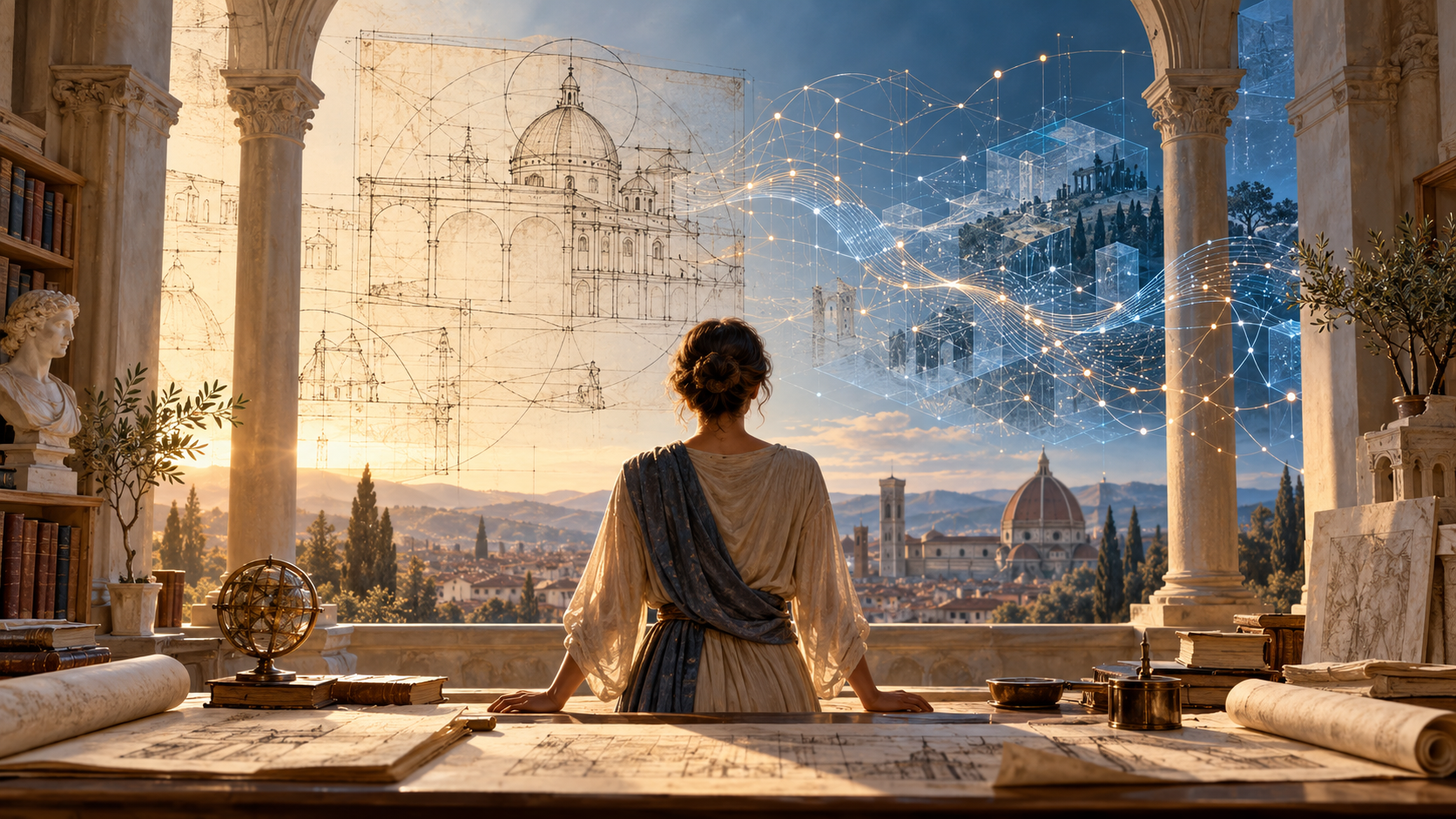
This conviction grows out of my own history. For more than thirty years I have studied Vitruvius and the Basilica of Fano, bringing the words of an ancient text into dialogue with material traces, drawings and digital reconstruction. Building a model taught me to question the sources: every form requires a choice; every gap poses a problem. I find the same need in my work with AI today.
In Vitruvius, practice and reasoning accompany an education that crosses disciplines. In Leonardo, the study of machines is in dialogue with anatomy and the observation of nature. The relationship between people and machines has ancient roots; AI transforms it because it also enters the activities through which we develop knowledge and make decisions. For me, returning to this history means recovering our ability to connect fields of knowledge as we face new problems.
From heritage to the laboratory
At Università Politecnica delle Marche I direct Maindh_Lab. Our group uses AI tools and develops algorithms and models, prepares data, and designs interactive systems and immersive environments. Tangible and intangible heritage is our starting point: works of art, buildings and landscapes, but also memories, practices and knowledge. From there we extend methods and applications to fashion, design, boating and other fields shaped by a culture of design.
Anyone speaking with a historical avatar soon faces a practical question: how can we distinguish what comes from a source from a reconstruction or an invention? A fluent answer can sound authoritative even when it is wrong. That is why sources and areas of uncertainty must remain visible. Technology has value when it helps people understand, rather than merely experience something engaging.
With Earth Memory we are exploring whether immersive experiences, avatars and AI can help sustain a connection with Earth during space missions. The research is ongoing, and its benefits still need to be tested. Yet the question behind it is profoundly cultural: what would we want to preserve from our lives if we had to spend a long time away from the world we know?
Trust, verification, responsibility
My trust in AI includes a willingness to be surprised and even corrected. An answer may reveal an unexpected connection and lead me to reframe the question. But trust grows only when we know how to verify. In research, teaching and creative work, we need to compare alternatives, recognise what is missing and discuss sources. The ease of obtaining a result makes it all the more important to understand how we arrived at it.
Human oversight must be a real possibility, supported by expertise, time and the power to intervene. A graphic proposal and a decision that affects a person's life require different levels of scrutiny. Those assessing a system must be able to access the information they need, challenge a result and stop a process. Responsibility cannot be reduced to a final signature.
A humanism to put into practice
Putting people at the centre means asking who gets to influence choices. Who defines the goals? Which languages, memories and cultures enter the data? Who can challenge a decision? The humanities have a place in design precisely here: they help us select relevant sources, recognise differences worth preserving and ask whom a technology is being built for. In the laboratory these questions guide development; technical experimentation forces us to make them more precise.
With this article I begin a continuing reflection on artificial intelligence, informed by the projects and people of Maindh_Lab. I will share what we are testing, the results and the questions still open. I hope this space will welcome dialogue with those who research, teach, design and use these technologies every day.
Vitruvio Italia
The Manifesto for a new Vitruvian humanism proposed by Vitruvio Italia expresses a principle at the heart of this journey: ‘artificial intelligence must expand human potential’. I invite everyone who shares this question to join the Vitruvio Italia group and bring experiences, ideas and doubts. From the memory of Vitruvius and Leonardo to the challenges of AI, together we can build a culture capable of guiding the power of our tools.
Join Vitruvio Italia