

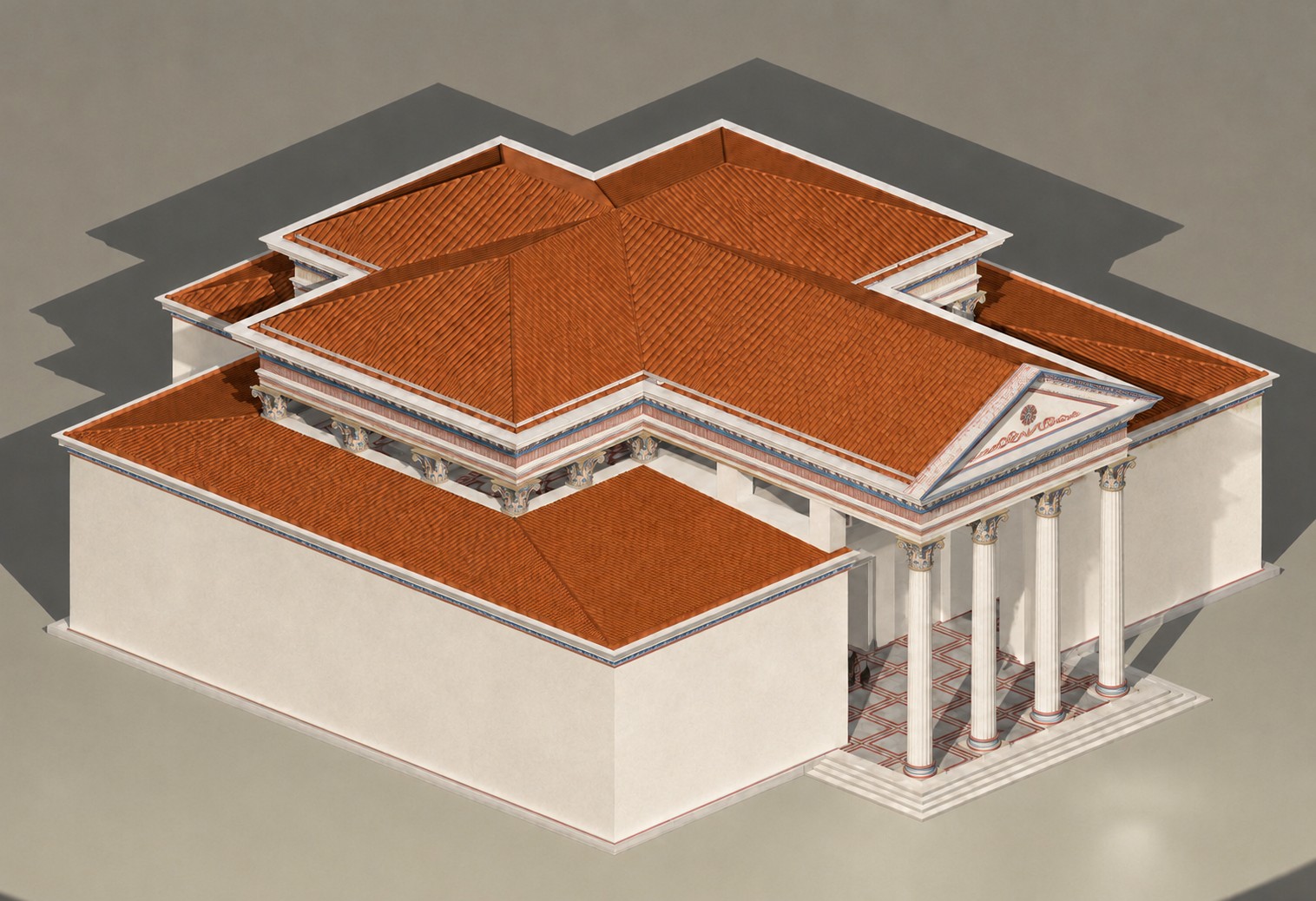
What excavation has revealed
Columns approximately 1.50 metres in diameter, walls, bases and floor preparations form a monumental layout consistent with Vitruvius’ description. Identification was officially announced in January 2026.
Vitruvius · Knowledge for everyone
Architecture, nature, measurement and machines: knowledge spanning our civilisation and speaking to everyone once more.
The Basilica of Fano offers a key to reading Vitruvius anew: it makes his thought tangible and opens new questions about the relationship between people, nature and technology. More than thirty years of research become a public story and shared knowledge.
The person, the knowledge, the legacy
Vitruvius gathers and systematises knowledge connecting architecture, the human body, the environment and machines. His De architectura travels across the ages, reread, interpreted and transformed: in my reading, a symphony accompanying our civilisation, from the ancient world to the Renaissance and the questions of today.
The Basilica of Fano, which Vitruvius describes in Book V as his own work, gives this story a material presence. Since 1992, I have studied how his words can become a coherent, verifiable space. Today, excavation reopens that dialogue and offers an opportunity to bring the author and his legacy back into public focus.
I want this knowledge to reach beyond specialist circles. Digital technologies and artificial intelligence can help everyone ask questions and find ways to understand: Vitruvius as a shared resource, a story belonging even to those encountering it for the first time.
His words have become stone again. His story belongs to everyone.
More than thirty years of research
A discovery does not happen in a day. It is the provisional outcome of a journey in which text, city, models and verification have continually questioned one another.
During my doctorate, I begin studying the Basilica and develop the first complete three-dimensional reconstruction of the building described in Book V of De architectura. The doctorate concludes in 1997.
Founding and directing the Centre brings research into an interdisciplinary public setting, connecting architecture, archaeology, philology and communication.
Bringing together sources, urban morphology, archaeological evidence and dimensional compatibility identifies this area as the most convincing proposed location for the Basilica.
The interpretative model becomes a testing laboratory: geometry, light, structural behaviour and construction techniques are examined and discussed within the scientific community.
Research expands to the original Vitruvian Man, the transmission of the treatise and machines, bringing together the complexity of Vitruvius’ thought.
The Ministry of Culture and the Soprintendenza announce the identification of the Basilica in Piazza Andrea Costa: text, model and archaeological material finally enter the same field of research.
New investigations explore structures, materials, phases of use and the organisation of the complex. Every finding may confirm, revise or open new questions.
De architectura · Book V
These measurements come from the Vitruvian text: they are the starting point for the model, not data obtained from excavation.
Method and responsibility
A discovery of this importance calls for equally precise language: what has emerged, what we can infer and what models allow us to test are different things.
Columns approximately 1.50 metres in diameter, walls, bases and floor preparations form a monumental layout consistent with Vitruvius’ description. Identification was officially announced in January 2026.
Position, proportions and scale reveal a building of exceptional height and complexity. Its full layout, phases and relationships with other spaces remain under investigation.
3D reconstruction, lighting simulations and structural analyses test the consistency of hypotheses. They do not replace archaeological evidence: they make measurable questions that would otherwise remain abstract.
We do not yet have all the answers. But today, for the first time, we can compare Vitruvius’ words, thirty years of digital research and the material revealed by excavation.
Inside the model
Every image represents a reconstruction hypothesis: it visualises spatial relationships and lighting conditions that must continue to be checked against sources and excavation.


1992
—
2026
My journey with the Basilica
From the first three-dimensional reconstruction to scientific verification, from the Centre for Vitruvian Studies to the discoveries of 2026, the Basilica has been much more than a research topic for me.
Today, that journey meets excavation. It is the most moving moment, but also the one requiring the greatest rigour: always distinguishing what has been found, what we can infer and what remains to be understood.
Selected scientific library
From my thesis on the Basilica to experimental verification and the dialogue between Vitruvius and Leonardo: five works tracing the development of the research over time.
Paolo Clini · MAPPE 25 · 2026 · pp. 11–17
An overview of the long research journey on the Basilica, as the story transmitted by sources finally meets the material evidence revealed in Fano.
Massimo Callegari, Paolo Clini, Luca Carbonari, Renato Angeloni, Mirco D’Alessio, Cecilia Scoccia · HMM 2022
Digital reconstruction brings ancient mechanics, Vitruvius’ description and Leonardo’s interpretation of the water clock into dialogue.
Paolo Clini, Massimo Callegari, Stefano Brillarelli, Renato Angeloni, Mirco D’Alessio · in Leonardo e Vitruvio. Oltre il cerchio e il quadrato · 2019 · pp. 132–151
Digital drawing and virtual reconstruction enable exploration of the machines described by Vitruvius and reinterpreted by Leonardo, connecting history, mechanics and communication.
Paolo Clini, Stefano Lenci, Daniela Amadei, Laura Bertuccioli, Elena Camerini, Cecilia del Gaiso · SCIRES-IT 4(1) · 2014
The three-dimensional model becomes a verification tool: geometry, statics and construction consistency contribute to evaluating the reconstruction hypothesis.
Paolo Clini · 1997
The work that begins a new reading of the Basilica, connecting historiography, surveying and reconstruction hypotheses.
Articles and insights
Water, light, the body and shared life: Vitruvius’s thought offers a cultural perspective on the future of the Carignano baths.
From founding a city to artificial intelligence: Vitruvius’s circular wisdom invites us to bring knowledge, experience and responsibility into dialogue.
The full recording of my keynote lecture at Passaggi Festival: a journey from Vitruvius to the present through architecture, cities and civilisation.
From the first three-dimensional model to the 2026 excavations: the journey that returned the Basilica described by Vitruvius to the centre of international debate.
Before deciding what to build or demolish, Fano needs the best possible visions for the Basilica area.
Papyrus scrolls, ink, tablets and memory: the material undertaking behind Vitruvius’ ten books.
Two spaces, two purposes
Research becomes a public story; Vitruvio Italia opens it to a shared vision of culture, innovation and participation. This website gives that dialogue depth and preserves its manifesto.
Follow De architectura, the history of the Basilica, discoveries and accessible scientific updates.
Follow the research Cultural community · FacebookShare a new humanism: memory and the future, technologies serving people, education, participation and culture as a shared resource.
Join the communitySources and updates